Collaboration
How to prepare a back-to-back DJ set together
Agree on the musical direction and the booth details before two libraries meet one dance floor.
The practical answer
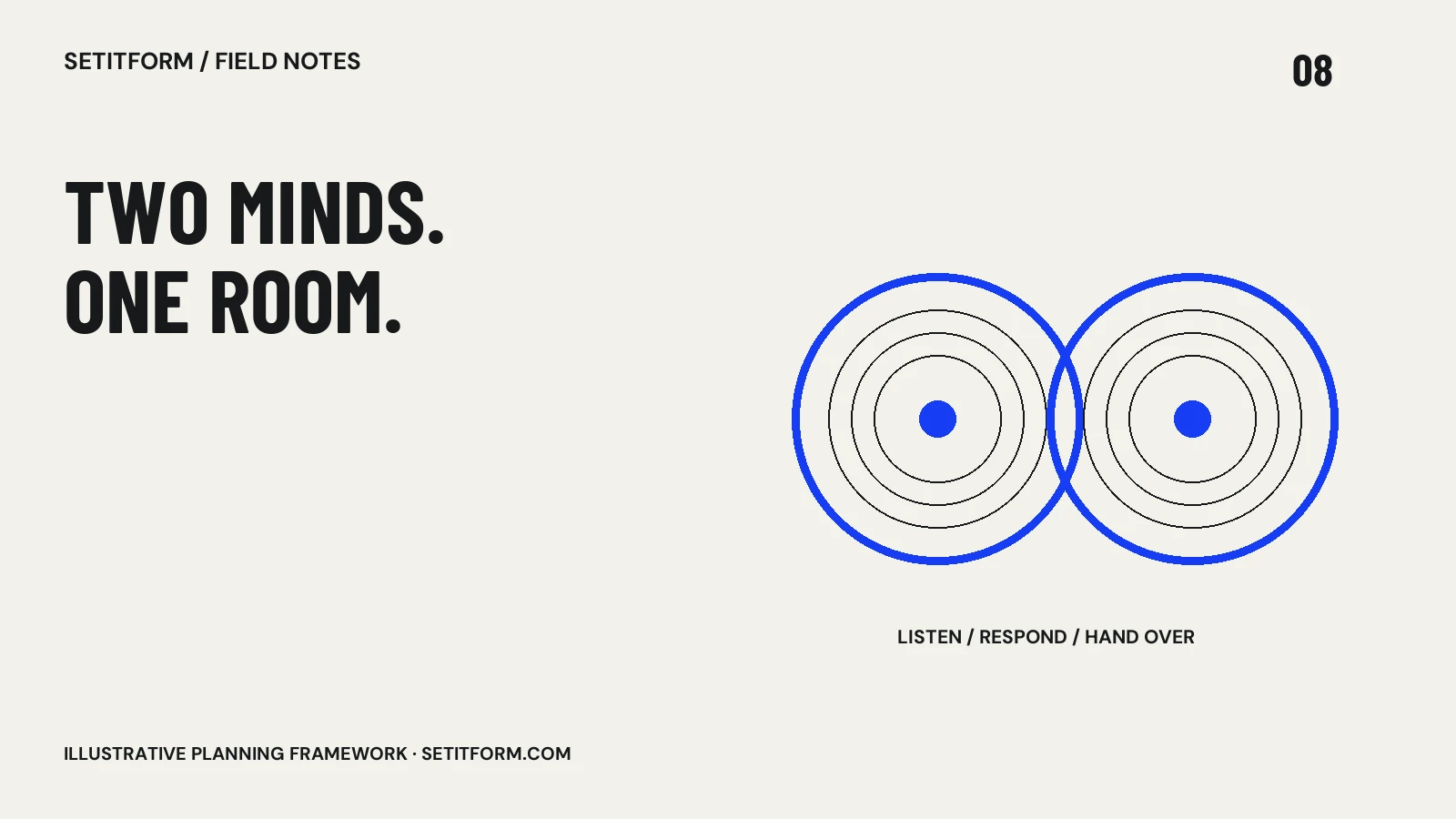
Prepare a B2B set by agreeing on the event’s purpose, a flexible turn-taking pattern, the equipment workflow and simple handover signals. Share reference tracks and practice a short session together, while keeping room for each DJ’s identity.
Share an event brief before sharing tracks
Compare what you each believe the slot needs: arrival, warm-up, headline or closing. Agree on the time window, the people before and after you, and any boundaries from the organizer. Discuss the musical territory you both want to explore and anything that would feel out of place. Two compatible tastes do not automatically imply the same interpretation of a booking. A short written brief gives you a shared reference when the room changes. Use reference tracks to make descriptions concrete, without turning them into a mandatory running order.
Choose a flexible turn-taking pattern
Decide whether the initial pattern is one track each, a short group of tracks, or longer sections. Treat it as a communication agreement rather than a competitive rule. Discuss what happens if a transition needs more time or one person has a clear direction worth following. Avoid changing the pattern silently in the booth. A simple signal can mean “one more track,” “take it after this” or “let this section breathe.” Rehearse the signal so neither person has to guess during a loud handover.
Make the equipment workflow explicit
Confirm player and mixer models, media compatibility, available inputs and any laptop changeover requirements with the venue. Work out where each person’s devices and cables will go. Keep essential controls accessible to both DJs and avoid a setup that requires unplugging the active source to switch performers. Discuss headphone monitoring and gain decisions. If either person depends on a particular feature, test it before the event. Equipment confidence comes from checking the actual chain; a shared genre preference cannot solve an unplanned connection problem.
Rehearse decisions, not just transitions
Try a short session in which each person responds to the other’s last selection. Include a restrained passage, a stronger moment and a deliberate change of direction. Afterward, compare the intent with what the other person heard. You may discover that one DJ reads a vocal track as a peak while the other hears it as a bridge. Discuss those differences without making every choice a negotiation. Agree on a few dependable reference points and retain the surprise that makes playing together worthwhile.
Keep private files and preparation under control
Share track names, reference links and notes in a way that respects access and ownership. Do not assume a subscription playlist gives the other person usable performance files. Each DJ should verify their own playback media and carry a backup. If you use Serato’s preparation workflow, its Prepare panel documentation is a useful reference for that application’s temporary selection behavior; check your version and save lasting plans appropriately. Keep shared event notes clear enough that either person can understand them without opening the other’s entire library.
Common questions
How many tracks should each DJ play in a B2B?
Agree on a starting pattern that suits the slot and your working relationship. There is no universal track count.
Do we need identical libraries?
No. Shared context and compatible playback preparation matter more than owning the same collection. Agree on how each person will access their own files.
Sources & approach
Preparation frameworks and examples are Setitform editorial guidance. Linked primary sources support the specific software or platform statements beside them; they do not endorse this article. Sources checked on 30 October 2026. Software and service terms can change.
Written with AI assistance and checked against the linked documentation. This article has not been independently reviewed by a named DJ. Read our editorial policy or send a correction.