Set flow
How to build a DJ set energy curve without chasing BPM
Map intensity, contrast and recovery without turning a crowd into a spreadsheet.
The practical answer
A DJ set energy curve is a planning sketch of how intensity changes over time. Judge energy through arrangement, rhythm, bass weight, vocal familiarity and contrast as well as tempo. Use the curve to prepare options, then adjust it to the room.
Separate tempo from intensity
BPM counts beats per minute; it does not describe the entire emotional effect of a record. A sparse track can feel spacious at a faster tempo, while a dense bassline and familiar chorus can make a slower selection feel bigger. Before drawing a curve, choose three reference tracks from your own library: restrained, driving and peak. Listen at comparable levels and explain the difference in ordinary words. The references make your personal energy scale more consistent. They do not create an objective measurement or a forecast of audience response.
Describe a journey in sections
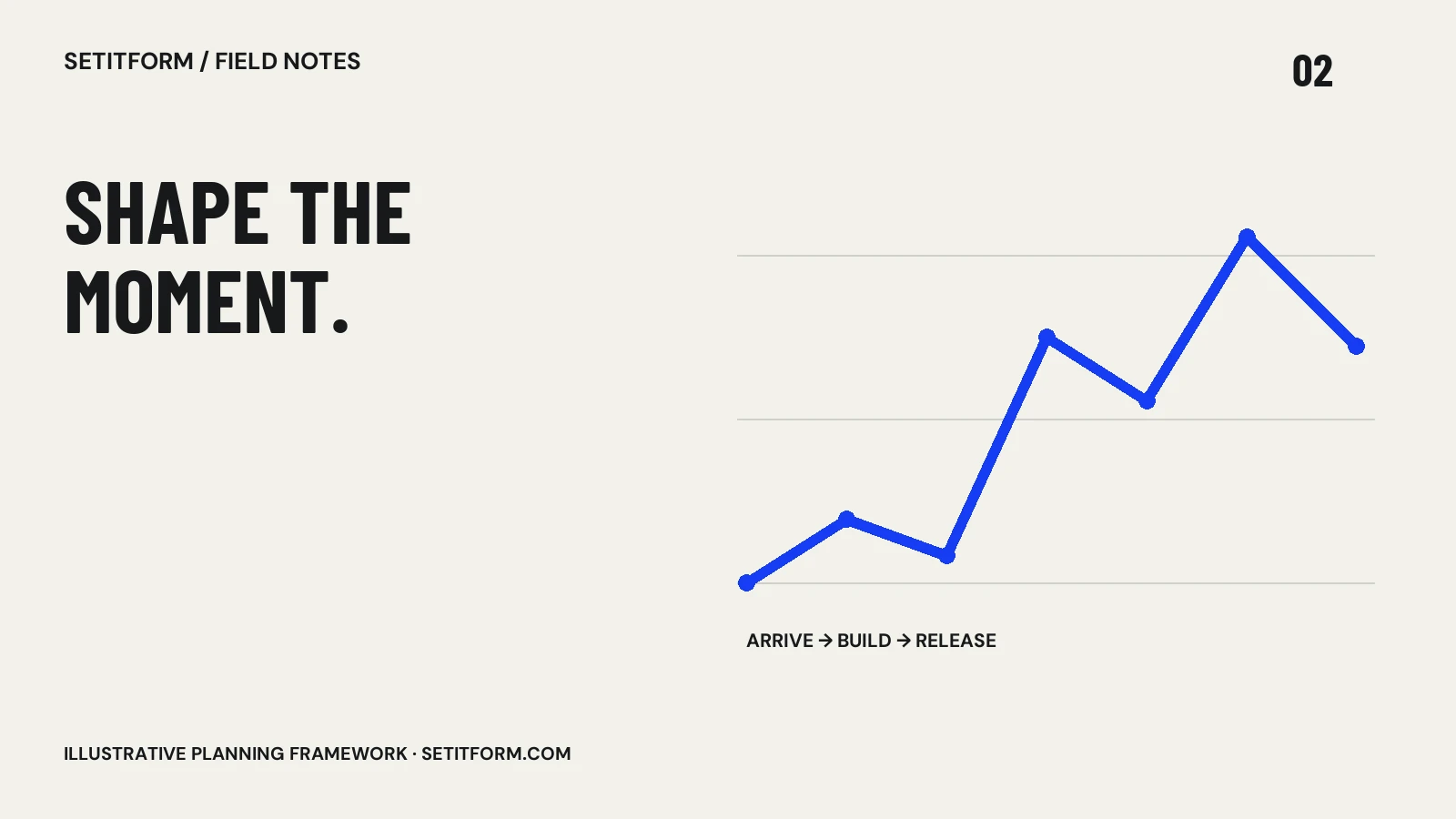
Divide a hypothetical 90-minute set into arrival, development, a main statement and handover. Give each section a purpose before assigning it a number. Arrival might invite movement without demanding attention; development might increase rhythmic commitment; a main statement might introduce the strongest contrast. Handover depends on the next artist and event, not an automatic fade to quiet. Our example visual uses relative intensity only. It is not measured crowd data. Your actual curve may plateau, dip, rebuild or start high because of the slot you inherit.
Make contrast a deliberate choice
An uninterrupted climb can leave little room for a later lift to feel meaningful. Prepare a less dense option after an intense passage and compare it with staying at the same pressure. Listen for whether the change creates breathing room or merely loses the thread. A reset can come from removing a vocal, simplifying percussion or choosing a longer groove; it does not always require dropping tempo. Try the contrast in rehearsal and judge its musical logic. A chart cannot tell you whether a particular breakdown is welcome at that moment.
Place decision points on the curve
At two or three points, prepare a choice: hold the groove, lift it or change direction. Write the evidence you would look for, such as whether the dancefloor is settling into the rhythm or whether arrivals are still finding the space. Avoid turning a single person leaving the floor into a verdict on the track. Context matters. If you do change course, make one understandable musical move and allow it to develop before changing again. This is a suggested decision framework, not a validated crowd-engagement model.
Rehearse the joins, then revise the sketch
Choose one pair from each section boundary and listen to the overlap. Does the bass handover produce the intended pressure? Are two large vocals competing? Is the incoming record actually more intense, or just louder? Mixed In Key’s energy workflow distinguishes key, tempo, arrangement and mix position as separate considerations. Use those categories as listening prompts rather than proof that a transition will work. After a gig, annotate where your planned direction changed and why. The useful artifact is the reasoning behind the curve, not a perfectly smooth line.
Common questions
Should energy always rise?
No. The appropriate shape depends on your role, the set before you, the room and the handover. Plateaus and deliberate contrasts can be useful.
Can AI predict the right energy curve?
It can propose a structure from a brief, but a proposed curve is not evidence that a particular audience will respond as predicted.
Sources & approach
Preparation frameworks and examples are Setitform editorial guidance. Linked primary sources support the specific software or platform statements beside them; they do not endorse this article. Sources checked on 30 October 2026. Software and service terms can change.
Written with AI assistance and checked against the linked documentation. This article has not been independently reviewed by a named DJ. Read our editorial policy or send a correction.